
Searching for a Warrant in Maui County
Hawaiʻi publishes no single statewide active-warrant database, and Maui County posts no public warrant roster. So the search runs in layers. eCourt Kōkua gives public case information. The Second Judicial Circuit clerk confirms a court event. Maui Police Department Records handles what police hold, and the Hawaiʻi State Sheriff Division answers for its own files. None of these channels works as a screening service for private people.
- Search your exact legal name in eCourt Kōkua and note the case ID, court, location, status, and last update.
- Open Events, Offenses, and bail or bond fields. Treat warrant codes only as clues.
- Call the matching Second Circuit counter and ask whether the warrant remains in force.
- For police-held material, make a precise request to MPD Records through GovQA, fax, or mail.
- Ask the State Sheriff Maui Section only about process or service records in its custody.
Bring the family member along, or get their written okay first. If a Maui County result hints at an active warrant, talk with a lawyer before you appear or surrender anywhere.
Maui County eCourt Kōkua Fields
The public Judiciary interface searches by party, vehicle, case, upcoming hearing, and documents. For a Maui County warrant lookup, Party Search is the sound first move. Start with the exact name. Partial and phonetic options cast a wider net, but they also pull in unrelated cases. Add a date range or case type only if you truly know it.
| Field | Use | Caution |
|---|---|---|
| First and last name | Required party identifiers | Use the legal spelling first |
| Partial or phonetic | Broader name match | May create false matches |
| Case ID | Direct case lookup | Best when already known |
| Plate or VIN | Traffic case route | Not a warrant roster |
| Filing range and type | Narrows results | Do not guess filters |
The system shows 20 results by default and can return up to 200 at once. Those counts are matched cases, not Maui County warrants.
Warrant Search Fields Explained
A search form and a case result answer different questions. The input finds a possible party or case; the output is court data that may point to warrant activity. A broad name match calls for careful identity checking, and collecting details about strangers is neither needed nor proper. Work from your own case number, citation, or official name. The eCourt Kōkua external-user manual walks through the controls and document access. Basic case information costs nothing. A PDF, when offered, runs $3 per document or 10 cents per page, whichever is greater, and electronic certification adds $2. Bought files stay available for two days. Those are document fees, not a charge to certify that no warrant exists in Maui County.
Maui County Codes Need Context
Judiciary event codes can shorten a long docket. They are no substitute for a clerk's current answer. The official CourtConnect code table supplies the vocabulary, while the event date and later orders show the true sequence of a Maui County case.
- FTA
- Failed to Appear, a common clue that bench-warrant action may follow.
- PCAW
- Probable Cause to Issue Arrest Warrant.
- MRBW
- Motion to Recall Bench Warrant.
- MQSH
- Motion to Quash, meaning a request to set process aside.
- RBW or RW
- Return Bench Warrant or Return on Warrant. Ask the clerk what the return changed.
Read earlier and later events together, never one alone. A motion filing proves nothing about whether it was granted, and an old return does not settle today's Maui County warrant status.
What a Warrant Search Shows
A public Maui County case record can show the court, case location, filing date, parties, offenses, events, related cases, and bail or bond details. The warrant document itself may stay out of view. A case ID can also differ from a process identifier. Copy identifiers exactly; never guess at a warrant-number format.
| Case or process ID | The court's locator, shown as a value such as CASE ID; preserve every character. |
|---|---|
| Court and location | Routes the question to Circuit, District, Family, or Traffic staff. |
| Events and dates | Shows the procedural sequence and last update. |
| Charge or offense | An allegation or case label, not proof of guilt. |
| Bail or bond | May show an amount or condition; only the court confirms what can be posted. |
| Status | Must be read with later recall, quash, return, or service entries. |
Confirm No-Result Maui County Searches
A blank screen cannot clear a person. The record may be sealed, confidential, juvenile, newly issued, not yet entered, or filed under another spelling. Traffic citations can take 13 days or longer to appear. A recalled event also needs time to sync across Maui County systems.
Key point: No eCourt result is not proof that no Maui County warrant exists. Confirm with the issuing court.
Use the court location printed on any notice or citation. In Wailuku, District Court clerks answer at (808) 244-2846, Traffic Violations at (808) 244-2800, and the legal-documents line for non-confidential Circuit matters at (808) 244-2969. For Lahaina, Hana, Lānaʻi, or Molokaʻi, the Second Circuit page lists each island contact. Call before you travel anywhere in Maui County.
Where to Check Warrants in Maui County
Maui County has no county sheriff and no municipal courts. Circuit Court, District Court, and Family Court all sit within the Hawaiʻi State Judiciary. MPD serves as the county police agency. The Sheriff Division is a statewide service, security, and transport unit with a Maui section. Each office answers only for the records in its own custody.
| Channel | Best use | Limit |
|---|---|---|
| eCourt Kōkua | Public case and event review | Not a complete warrant list |
| Second Circuit clerk | Current court status and filing route | No legal advice |
| MPD Records | Police-held reports and legal documents | Redaction and custody rules apply |
| State Sheriff Maui Section | Sheriff-held service or process question | Not a public statewide database |
Only the issuing court can finally say whether a Maui County warrant was recalled, quashed, served, or still stands.
MPD Records Fallback for Maui County Warrants
MPD Records processes legal documents, warrants included, and keeps active NCIC entries current. That duty does not create a public online NCIC search. For your own record, file through Maui County GovQA, fax (808) 244-6418, or mail MPD Records Section, 55 Mahalani Street, Wailuku, HI 96793. Include contact details, a clear description, and legible photo identification when required. The official MPD Records page spells out these duties in full.
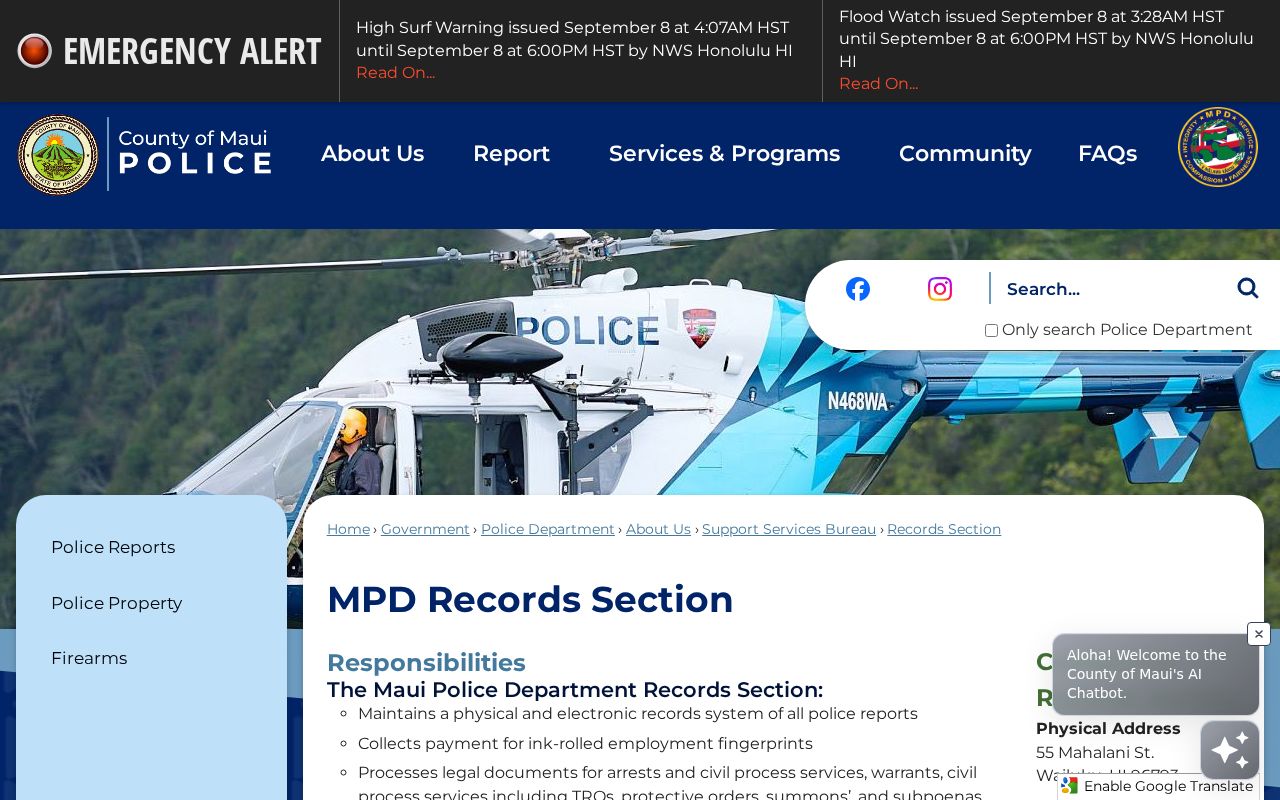
This route separates an agency-held document from the judicial status only the court can confirm. MPD says most police reports go out within 10 business days, but that is no promise about warrant status. Requests under 25 pages may be free. Larger ones can carry posted copy and review charges.
Maui County Records Request Routes
The official police-report page explains online, fax, and mail paths.
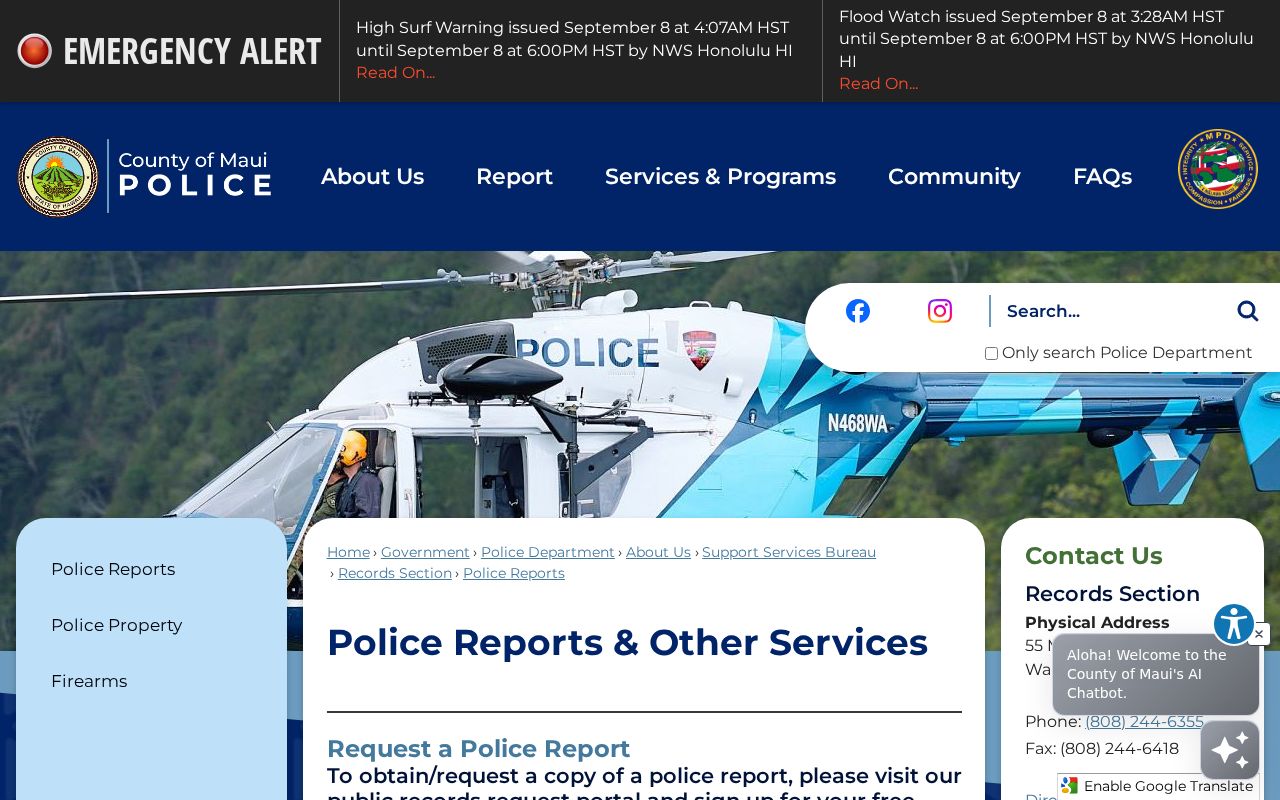
The request route covers records MPD holds; the court still controls warrant status and its own filings. The county request center on the GovQA page shows the intake options without exposing any submitted request.
Name the exact own-record document you want. Under Hawaiʻi's UIPA, a Maui County office has no duty to build a new roster or compilation to fill a request.
Restricted Warrants and Access Rules
Hawaiʻi presumes records are open. HRS §92F-11 opens them unless law says otherwise, while HRS §92F-13 closes some for privacy, prosecution work, legitimate government functions, or by law or court order. Juvenile and Family Court information in Maui County gets added protection under HRS §571-84.
Access rule: Public access does not mean every warrant, affidavit, NCIC entry, juvenile matter, or unserved operational detail must be disclosed.
A community name does not create its own city warrant system in Maui County. See MPD's official patrol geography.
Warrant status belongs to the Second Circuit. Maui County residents get answers there no matter which patrol district serves them. Note: Verify any warrant through the issuing court before relying on a public case screen or agency record.
Maui County Search Identity Checks
A shared name proves nothing in a Maui County warrant search. Match only identifiers you already hold. A notice, citation, or court papers carry the details worth comparing. Case location, filing date, case type, and exact legal spelling can separate results without pulling private data on people who share the name. Read each page of a narrow result first. Widen the query only after that. Partial and phonetic searches catch spelling variants, yet they raise the odds of a false match. If doubt remains, give the clerk the exact case number and ask what public information can be confirmed.