
Maui County Arrest Warrants Explained
Hawaiʻi's state courts issue every Maui County arrest warrant after a judge finds probable cause. It is a court order. A police note or list entry is something else. HRS chapter 803 separates arrest by warrant from warrantless arrest. When the record is public, it may show the complaint, the offense, the issuing court, and later events. The Second Judicial Circuit spans Maui, Molokaʻi, and Lānaʻi. Circuit Court takes the serious felonies. District Court handles misdemeanors, petty misdemeanors, violations, traffic matters, and preliminary work. So the charge and the stage decide which court holds a Maui County arrest-warrant record. Police or the State Sheriff Division can execute it, yet the issuing court still controls the record.
Maui County PCAW Events Are Docket Clues
Maui County dockets use codes, and PCAW is one of them. The Judiciary's code table defines PCAW as Probable Cause to Issue Arrest Warrant. Spotting it tells you an event happened. It does not settle current status. Later entries may reflect issuance, return, recall, quash, or another action. The official CourtConnect code table lists PCAW beside FTA, MRBW, MQSH, RBW, and RW. Treat each abbreviation as a clue. Then ask the clerk whether a signed order or later event has changed the status of the Maui County arrest warrant.
Inside a Maui County Arrest Warrant
A public warrant document or case screen can carry identifying and procedural fields. Availability varies by case. Affidavits, addresses, service details, sealed records, and operational material may be withheld. Bring the case ID and court location to request the correct Maui County record.
| Case ID | The Judiciary identifier used to locate the case and public documents. |
|---|---|
| Named subject | The person identified in the process, subject to access limits. |
| Offense | The alleged offense tied to review, not a finding of guilt. |
| Issuing court | The Second Circuit division and location controlling the record. |
| Event date | The date for the filing, order, or docket event. |
| Bail or bond | Public terms when available; a blank does not prove none exists. |
| Status or return | Events that may show issue, service, return, recall, or later action. |
Maui County courts publish no fixed warrant-number format. A cue such as CASE ID FROM COURT RECORD points to the record the clerk actually uses.
When Maui County Police and Court Records Diverge
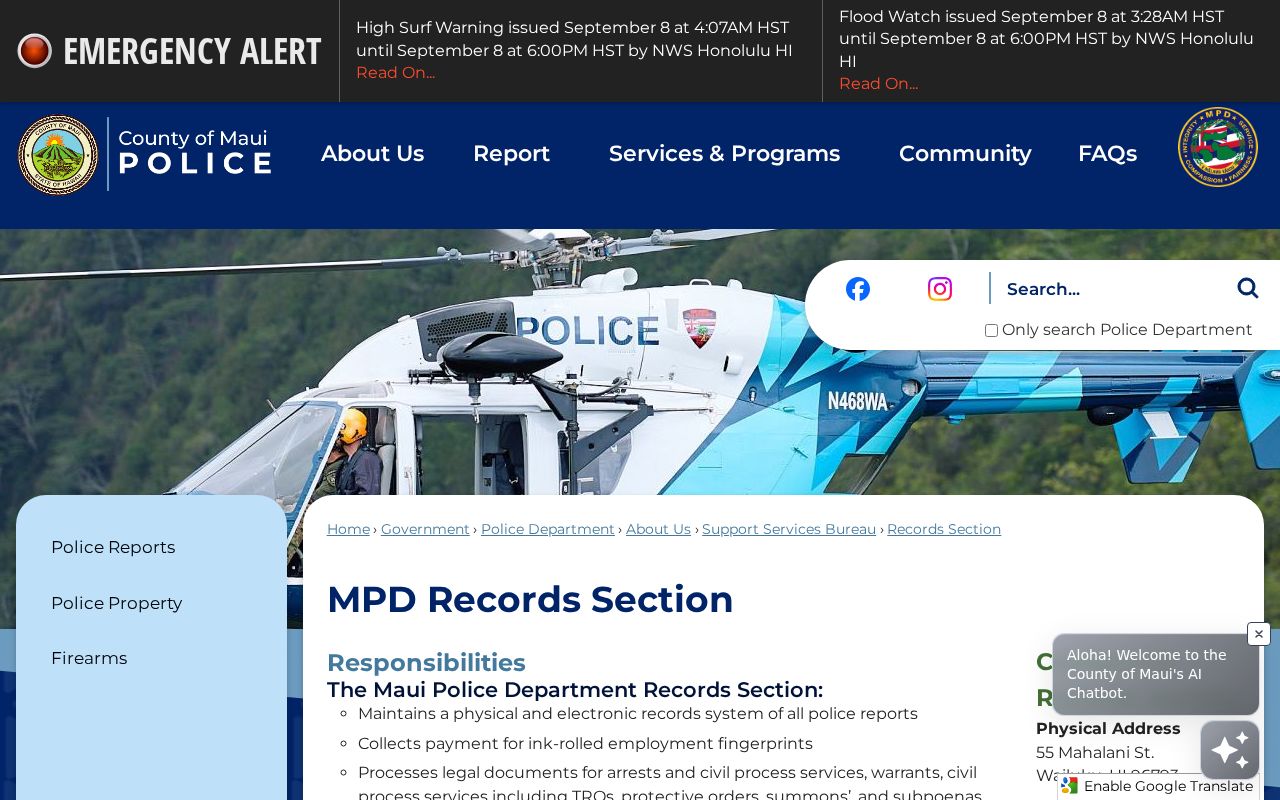
Maui County's MPD Records unit handles legal documents tied to arrests and warrants and maintains active NCIC entries. That is a custody role, not a case record. A police file may cover receipt, entry, service, or another operational step. eCourt instead shows the court's filings and orders. Timing, sealing, and system boundaries can make the views differ, and the MPD Records Section page lists the department's warrant duties.
For a court order, call legal documents at (808) 244-2969 or District Court clerks at (808) 244-2846. Ask about Maui County police-held material separately. HRS §92F-13 may shield information when release would invade privacy, affect a prosecution, frustrate a legitimate government function, or violate another confidentiality rule. The issuing court, not MPD, answers current warrant status.
Serving Arrest Warrants in Maui County
Several officers can execute a Maui County arrest warrant. MPD, the statewide Hawaiʻi Sheriff Division, or another authorized officer may serve it. Maui County has no county sheriff. The State Sheriff Division provides process service, security, and transport, including through its Maui section. It is not the issuing court. Nor is it a warrant-status counter for every case. HRS §803-6 addresses showing an arrest warrant on request as the statute provides. The same statute permits a citation instead of arrest for specified misdemeanors, petty misdemeanors, or violations when the officer reasonably believes the person will appear and no outstanding arrest warrant exists. That does not make every citation a warrant matter. The MPD station page describes countywide patrol geography.
The six patrol districts explain county service without inventing separate city police warrant systems.
Ask the Maui County Clerk Before Surrender
Confirm the case, court, and latest event. Then call. Search eCourt Kōkua by exact legal name or known case ID before you dial the Maui County clerk. Circuit legal documents is (808) 244-2969, District clerks are (808) 244-2846, and general information is (808) 244-2706. Island dockets differ. Lahaina, Hana, Lānaʻi, and Molokaʻi each may need their own route.
- Record the case ID, location, last update, offense, and any PCAW or return event.
- Ask which court controls the current Maui County arrest warrant record.
- Ask a Hawaiʻi attorney about surrender, hearing, bond, or motion procedure.
- Use only official court or authorized booking instructions.
- Keep the signed order, receipt, or updated event showing the outcome.
Maui County publishes no universal arrest-warrant bond schedule. HRS §804-9 makes bail discretionary and calls for a reasonable amount tied to the offense, the possible punishment, and financial ability. A blank online field does not establish the terms.
Comparing Arrest, Summons, and Bench Warrants
Maui County courts use several related instruments, each with a distinct purpose. A penal summons calls for appearance without immediate arrest. A bench warrant usually follows a missed court duty. For recall procedure in more depth, see the Maui County bench warrant search.
| Process | Function | Basis | Response |
|---|---|---|---|
| Arrest warrant | Authorizes custody | Judicial probable cause | Confirm; seek counsel on surrender and bond |
| Penal summons | Orders appearance | Criminal court process | Appear as ordered |
| Bench warrant | Authorizes arrest for a court duty | Missed appearance or noncompliance | Ask about appearance and recall or quash |
| Search warrant | Authorizes search or seizure | Separate probable cause | Do not treat it as arrest process |
A Maui County Police Request Is a Focused Fallback
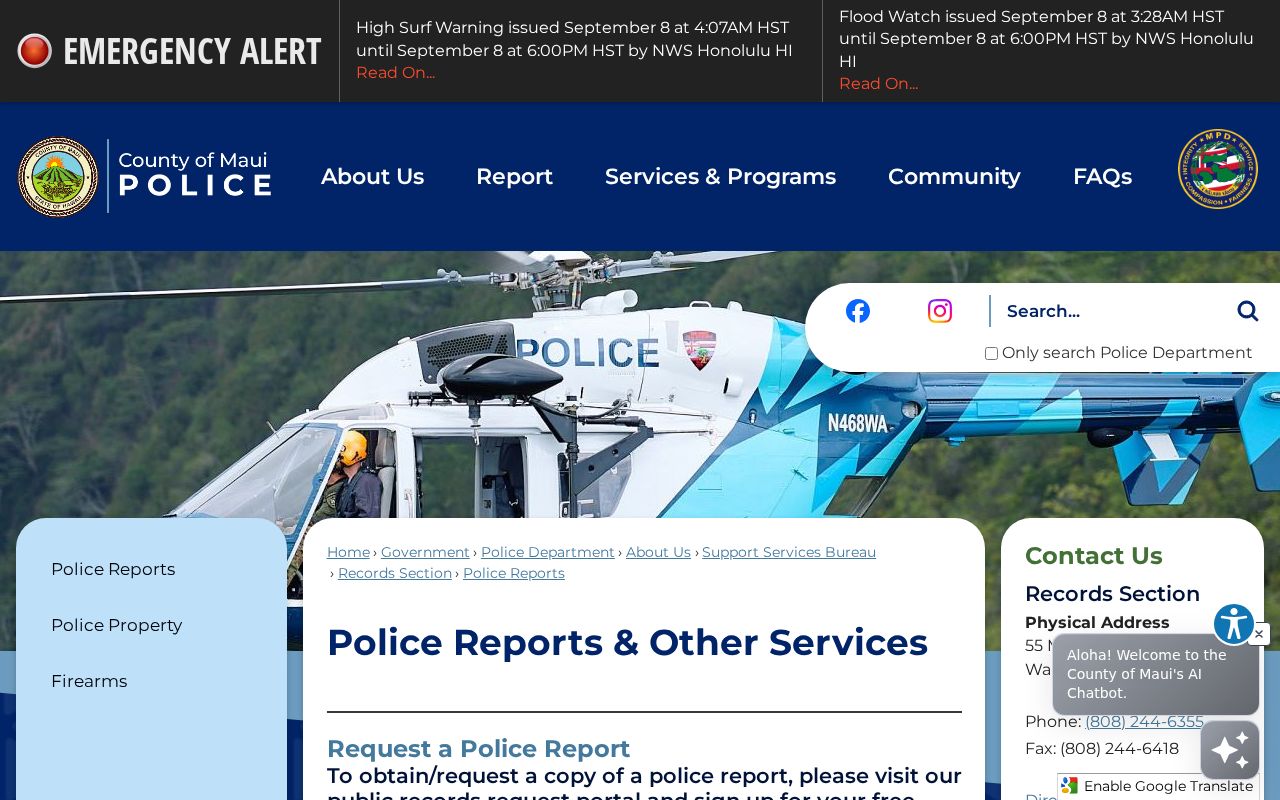
For an MPD-held record, use the GovQA Public Records Center, fax, or mail. Describe the record and add contact details. Include photo identification when required. A representative needs signed authorization and identification, and the official police-report page explains methods, identification, fees, and limits.
Those instructions cover Maui County agency-held records. They are not a real-time arrest warrant roster. MPD states that most reports are provided within 10 business days, but that pace is a report target, not a warrant-confirmation deadline. Requests under 25 pages may have no fee. Larger requests may incur posted copy, media, search, review, or segregation costs, and the Uniform Information Practices Act does not require a new compilation that is not readily retrievable.
If There Is an Arrest Warrant for You
A paid fine, a filed motion, or an eCourt change does not automatically clear a Maui County arrest warrant. Do not assume. Confirm with the issuing court what it accepts. The lawful route may involve counsel, a scheduled appearance, arranged surrender, court-set bond, or a motion to recall or quash. A clerk can explain procedure but cannot promise an outcome.
Important: Speak with a Hawaiʻi attorney before surrender; confirm bond and appearance instructions directly with the issuing Maui County court.
Get proof in writing. A signed order, receipt, or updated event from the Maui County court works best. Systems can lag, so hold onto it. If an MPD entry stays wrong, send a focused correction request with the court order rather than asking police to alter a judgment.
Maui County GovQA Does Not Replace the Court
The Maui County GovQA system helps with material in MPD custody. It is not a warrant roster. Nor does it expose NCIC operational data. It cannot decide whether a judicial order remains active, so search the court first, confirm with the clerk, then request a clearly described police record. The Maui County GovQA portal provides official submit-request controls.
Scammers call claiming a Maui County arrest warrant. They demand gift cards, cryptocurrency, Cash App, Venmo, or card details to clear it. Hang up. MPD and Judiciary warnings say to verify through official numbers. MPD nonemergency is (808) 244-6400. An unsolicited threat is not proof of a warrant.