
Maui County Bench Warrants Explained
The County of Maui definition describes a bench warrant as a written court order directing police or the sheriff to arrest someone. The grounds vary. They include a failure to appear, disobedience of a court order, or a grand jury indictment. Most Maui County bench warrant questions involve a missed criminal appearance, a required traffic-crime appearance, or an uncompleted court act. An unpaid civil ticket alone is not enough. Where the case sits depends on the charge. District Court handles misdemeanors, petty misdemeanors, violations, traffic cases, and preliminary matters. Circuit Court handles the more serious criminal cases. Family Court runs a separate process. Its juvenile warrant records stay restricted, so the type and place of the case point you to the correct Maui County clerk.
Maui County FTA Event Path
The Judiciary’s CourtConnect code list defines FTA as failed to appear. MRBW marks a motion to recall a bench warrant. MQSH marks a motion to quash. RBW means return bench warrant. RW is the return on warrant, and none of these codes proves a warrant clear. Treat them as docket clues. The usual path runs from a missed appearance through a court event, issuance of process, possible service, and later court action on a Maui County bench warrant. Only the clerk can confirm whether it stays active.
- FTA
- Failed to appear at a required setting.
- Recall
- The court withdraws the warrant.
- Quash
- The court sets process aside under its procedure.
- Return
- Process comes back to the court with a recorded result.
How Maui County Bench Warrants Are Issued
In Maui County, a judge signs a bench warrant inside an existing court matter after a qualifying failure to appear or comply. The order authorizes arrest. In Maui County, service can fall to the Maui Police Department, the Hawaiʻi State Sheriff Division, or another authorized officer. Maui County has no county sheriff of its own. The Sheriff’s Maui section answers to a statewide agency. The Second Circuit Bench Warrant form 2DC03 shows the formal structure of the Maui County bench warrant. Its court fields show why the order controls issuance. Once issued, the process can sit in court and law-enforcement systems until service or later court action.
Maui County Recall Form Fields
The clearest public recall artifact for Maui County is the Maui traffic Motion to Recall Bench Warrant. That form asks for motorist or attorney information, a license number, case and count, bench-warrant order date, hearing date, reason, declaration, signature, and certificate of service. It fits traffic matters. It is not a universal form.
| Case identity | Case or citation details and court location. |
|---|---|
| Warrant event | Order date and related count. |
| Requested action | Reason for recall and proposed appearance. |
| Service proof | Certificate showing delivery to required recipients. |
Timing rules appear on the certificate of service. Hand delivery should occur at least 48 hours before the hearing. Mail should be postmarked at least four days before the date, weekends and legal holidays excluded. The current Maui County form and court deadline control. The official Maui forms index lays out the relevant court resources.
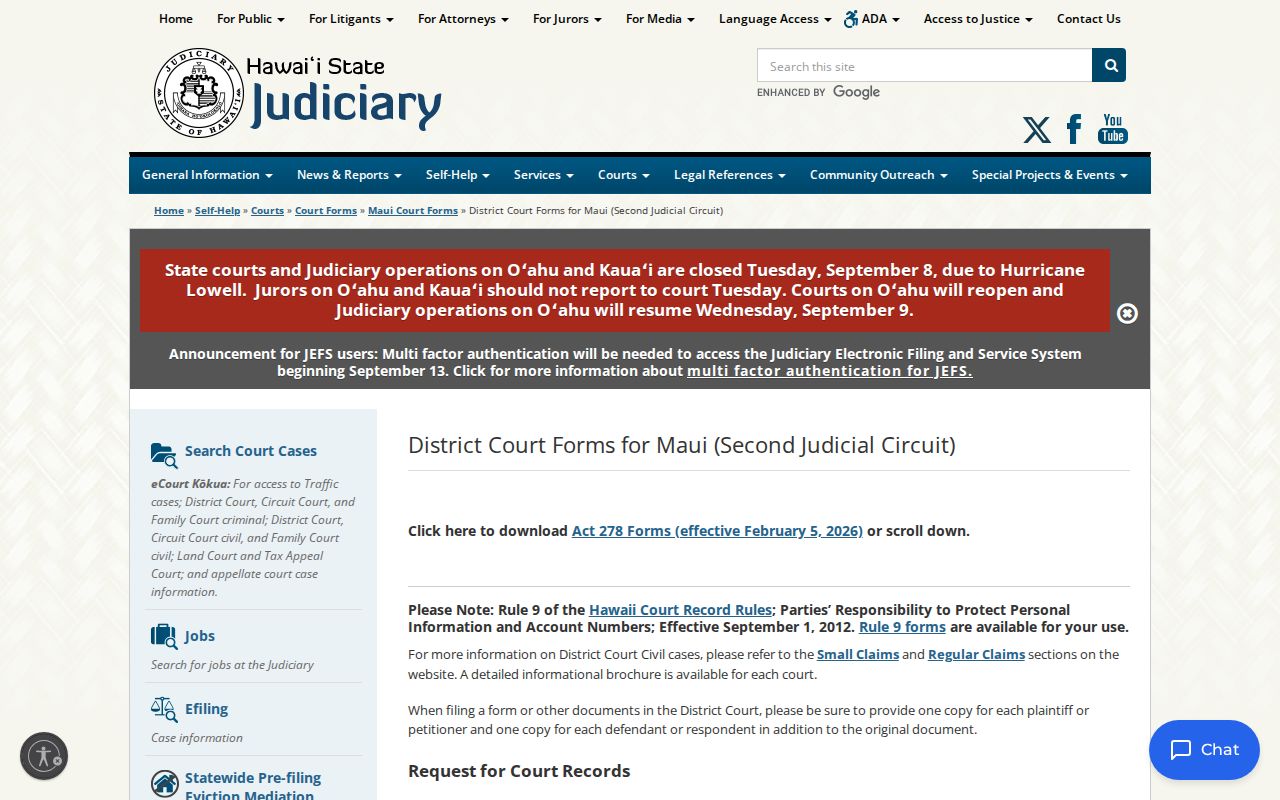
Maui County organizes its bench warrant records and forms through the Second Circuit. No county sheriff portal handles them.
Bench Warrants and Arrest Warrants Compared
Both a bench warrant and an arrest warrant can authorize arrest, but their bases differ in Maui County. A bench warrant answers an existing court obligation. An arrest warrant rests on probable cause and need not stem from a missed setting. A search warrant authorizes a search or seizure instead.
| Feature | Bench warrant | Arrest warrant |
|---|---|---|
| Main basis | Missed appearance or failure to comply | Judicial probable cause |
| Case posture | Existing court obligation | New or pending charge |
| Public clue | FTA, MRBW, MQSH, RBW | PCAW or warrant event |
| Next step | Ask about appearance or recall | Ask about counsel, surrender, or bond |
See the Maui County arrest warrant search for the separate probable-cause path.
Maui County Recall Is Not Filing
Filing a motion is not recall. MRBW only marks a motion event, and the later order or status entry shows what a Maui County court decided on the docket. MQSH carries a different label.
Key point: Keep the signed order, receipt, certified clearance, or updated event that proves the court acted.
eCourt’s last-updated field for Maui County cases can lag. If an agency record stays wrong, send a focused correction request with the court order to the custodian, since MPD cannot change a court judgment.
Resolving a Maui County Bench Warrant
Start with verification in Maui County. The court may accept a motion, set an appearance, require bond, or have counsel arrange a lawful surrender. Maui posts no walk-in surrender window, so call first.
- Search eCourt Kōkua with your own information and note the case ID, court, location, events, and last update.
- Call District clerks at (808) 244-2846, Traffic Violations at (808) 244-2800, Circuit legal documents at (808) 244-2969, or Family Court at (808) 244-2700.
- Ask whether the court accepts an appearance, recall or quash motion, bond, or attorney-arranged procedure.
- Follow current filing and service instructions, then obtain written proof.
Caution: A Maui County bench warrant is not safely treated as expired merely because officers have not served it.
Maui County Warrant Costs
HRS §607-8.5 lets the court charge up to $50 for issuing a bench warrant after a failure to appear or comply. That is a ceiling, not a fixed fee. Maui County publishes no bond schedule. When bail is set, HRS §804-9 demands reasonableness in light of the offense, the possible punishment, and the person’s financial ability. Ask the court or an authorized booking counter for the amount, accepted form, receipt, conditions, and next date. Never send money to an unsolicited caller.
Finding the Court That Issued the Warrant
The Second Circuit serves Maui, Molokaʻi, and Lānaʻi. The Maui court contact page lists Hoapili Hale, District and Family contacts, Traffic Violations, and island locations across Maui County. Court and Maui County police records have different custodians.
Second Circuit courts
Circuit legal documents: (808) 244-2969
District clerks: (808) 244-2846
Family Court: (808) 244-2700
Service and police records
MPD Records: (808) 244-6355
State Sheriff Maui section: (808) 244-2900
Juvenile warrant records in Maui County are restricted. An authorized party should contact Family Court rather than hunt for a public juvenile warrant lookup.
Maui County No-Result Checks
A blank search does not settle anything. No office in Maui County publishes a complete public bench warrant roster, and eCourt is a case tool rather than a full warrant database. Confidential files stay out. So do juvenile, sealed, and recently issued records, along with operational police material. An empty result is just that. It does not prove that no warrant exists, so keep digging through the offices that actually hold warrant records. For anything court-related, call the clerk. For police-held records that qualify, use MPD’s GovQA, fax, or mail routes. A good request names your own record, describes what you want, gives contact information, and includes identification when required. Expect fees, and expect redactions too. MPD Records sits at 55 Mahalani Street in Wailuku, and the listed number is (808) 244-6355. The State Sheriff Maui section can address records in its own custody, though it cannot replace the court. On Molokaʻi or Lānaʻi, call before you travel. The Second Circuit contact page lists the island court facilities, while central legal-document and Traffic Violations work happens in Wailuku. Ask whether the local court can answer your status question, whether a document must come from Hoapili Hale, and whether a hearing is required. This layered approach is the sound path for checking your own status, and it should end with a court confirmation rather than repeated name searches. Note: Confirm any online result with the issuing court before relying on it or making an appearance.